
Add Row
Add Element
cropper
update
Caribbean Streaming Network
update
Add Element
  • Home
  • Categories
    • Caribbean
    • Streaming
    • Culture
    • Music
    • News
    • Sports
    • Entertainment
    • Islands
    • Community
    • Global
    • Food
    • Music
July 07.2025
2 Minutes Read

CARICOM's Strategic Response to Global Uncertainty: Insights from PM Holness

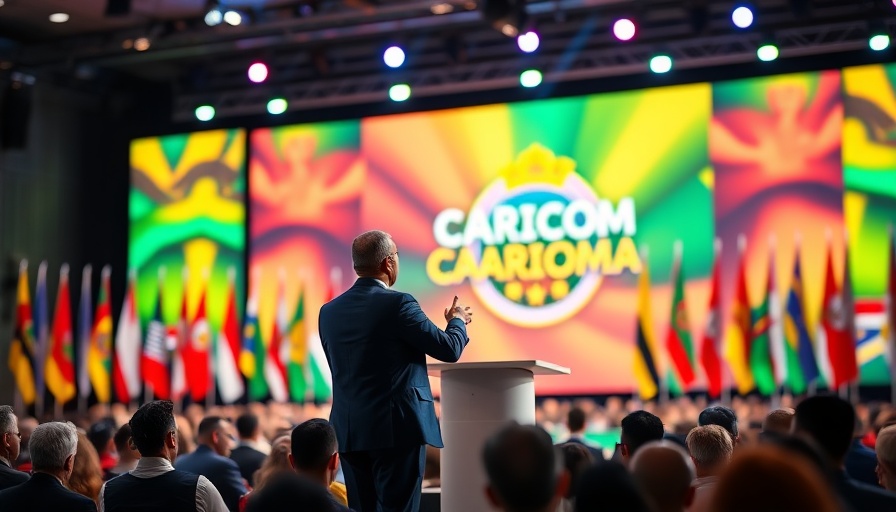
Speaker at CARICOM event with flags and audience, discussing strategic approach.

The Importance of CARICOM's Strategic Approach

In a world where powerful nations often dominate global dynamics, CARICOM leaders are recognizing the necessity of a united front. Prime Minister Andrew Holness has articulated that small states, like those within CARICOM, must prioritize security and resilience. This approach is essential to safeguard their interests against potential marginalization.

Why Collaboration is Key for Small Nations

Reflecting on the challenges faced by Caribbean countries, Holness emphasized the importance of collaboration during the 49th Regular Meeting of the Conference of Heads of Government of CARICOM. Vulnerable to global economic shocks and natural disasters, he noted that without teamwork, these nations risk being overlooked in international decision-making.

Understanding the Theme: People, Partnership, and Prosperity

The conference's theme, ‘People, Partnership and Prosperity – Promoting a Secure and Sustainable Future,’ encapsulates the collective vision of CARICOM. The focus on these three pillars emphasizes the essential components of fostering a stable environment for growth. Holness pointed out that security is not just beneficial but necessary for genuine prosperity.

Challenges Ahead and the Path Forward

Despite historical inequalities, there exists a potential for inclusive growth. The prime minister urged regional partners to champion initiatives targeting human development, food security, and sustainable partnerships with global allies. Bold action, according to Holness, is critical to translate aspirations into tangible outcomes.

A Call for Responsibility in Regional Affairs

As Caribbean nations face shifting global winds, they must take responsibility for their own futures. Holness emphasizes strengthening institutions to effectively shape destiny rather than rely on external factors for concessions. By fostering local leadership and resilience, CARICOM members can better navigate the complexities of international politics.

Looking to the Future: Opportunities for the Caribbean

As the CARICOM heads of government converge, the discussions center around creating stronger futures. The commitment to addressing climate change, enhancing job opportunities, and ensuring food security reflects a comprehensive strategy. Together, these nations can leverage their collective potential.

Final Thoughts: The Significance of Unified Action

In these challenging times, the take-away is clear: CARICOM must adopt a strategic approach and work together. As PM Holness aptly points out, strength lies in unity. Whether it’s climate resilience or economic development, collaborative action is the key to thriving in an unpredictable world.

Global

35 Views

0 Comments

Write A Comment

*
*
Related Posts All Posts
11.27.2025

How Less Than a Cup of Coffee Could End World Hunger

Update Ending Hunger: A Simple Solution That Costs Less Than Coffee Imagine if the cost of less than a cup of coffee could end world hunger within five years. Sir Ronald Sanders, the Ambassador of Antigua and Barbuda to the USA, argues that this remarkable reality is just within our grasp. Currently, billions spent on military expenditures starkly contrasts with the relatively small investment needed to eradicate hunger, posing an ethical dilemma about our global priorities. Understanding the Hunger Crisis According to the World Food Programme (WFP), around 318 million individuals face acute hunger due to various factors, including conflict and climate change. Malnutrition also has horrifying effects; malnourished children are at a much higher risk of mortality. Today's hunger crisis is primarily driven by war and economic instability, as evident in regions from Syria to Yemen. The Economics Behind Ending Hunger Sanders proposes a modest global levy of just $0.75 per barrel of oil produced, which could generate approximately USD 28 billion annually—nearly USD 50 billion more than the goal to end hunger set by the UN. As global oil production is concentrated in a handful of countries, achieving this goal could be feasible if governments worldwide cooperate. Long-Term Solutions Require Collective Action The private sector also has an essential role to play. Initiatives like General Mills partnering with the WFP to fortify rice in India highlight the potential for innovative solutions that bridge the gap between hunger relief and economic development. When governments and businesses unite, the road to food security becomes clearer, proving that we can fight hunger collaboratively. The Responsibility of Oil Producers With most oil production concentrated in a few countries, an ethical responsibility exists to help fund hunger alleviation. Countries like the USA and Saudi Arabia can use their influence to motivate change in oil revenues toward humanitarian aid. This could preserve humanity’s dignity and contribute to global stability. Join the Fight Against Hunger While challenges persist, the difference between suffering and survival for millions of people is just a fraction of our everyday expenditures. Consider advocating for policy changes that support hunger alleviation efforts and support organizations working toward these goals. Together, we can build a world where no one goes to bed hungry and where adequate nutrition is a fundamental right.

11.27.2025

How a 75-Cent Contribution Could Help End Global Hunger

Update Could 75 Cents End Global Hunger? Every day, we pay for luxuries like our morning cup of coffee. But what if for less than that cost—just $0.75—we could help end world hunger? Sir Ronald Sanders, the Ambassador of Antigua and Barbuda, believes this is possible through a simple yet effective global initiative: a humanitarian contribution from oil production. The Stark Contrast: Funding for Hunger vs. Military According to the United Nations, the world could eradicate hunger by 2030 with just $93 billion a year. This amount pales in comparison to the $21.9 trillion spent on military activities over the past decade. What this highlights is a shocking disparity between our values and societal priorities; while billions are funneled into defense, we struggle to come together to alleviate hunger. Turning Oil Wealth into Food Security Sanders proposes leveraging oil production for humanitarian aid. By imposing a modest fee of $0.75 per barrel of oil produced globally, we could raise approximately $140 billion over five years, thus exceeding the UN’s hunger eradication estimates. This solution rests not just on moral obligations but on practical feasibility. With top oil producers like the U.S., Saudi Arabia, and Russia responsible for the bulk of global output, coordinated efforts from these countries could make a profound difference. The Need for Collective Action Despite potential skepticism about the willingness of the oil industry to cooperate, the real conversation should focus on collective governmental action. Nations could implement this initiative at the extraction point, ensuring that those who reap significant profits contribute towards addressing this crisis. As much as oil has fueled development, it has also escalated the consequences of climate change—further exacerbating food insecurity across vulnerable regions. Ending Hunger is Possible The crux of Sanders’ argument is not just about economics; it is a call for responsible stewardship of our resources to foster a world where no one is hungry. It challenges us as global citizens to reflect on our shared responsibilities, urging action that aligns values with priorities. When we think about how to contribute toward this noble goal, it's clear that transforming a small fraction of oil wealth into food security is not just feasible, but imperative. It’s about making conscious choices for humanity—because at the end of the day, everyone deserves a full plate.

11.25.2025

Femicide in Latin America: Over 19,000 Lives Lost in Five Years

Update The Alarming Rate of Femicide in Latin America and the Caribbean In the last five years, a staggering total of at least 19,254 femicides have been documented in Latin America and the Caribbean, shedding light on a severe and disturbing trend. In 2024 alone, it was reported that 3,828 women lost their lives due to gender-related killings across 26 countries in the region. This figure translates to a heart-wrenching average of more than 11 women killed every day. Understanding Femicide: A Continuum of Violence Femicide, defined as the killing of women or girls because of their gender, stems from a broader spectrum of violence that disproportionately targets women. Often, these tragic events are preceded by acts of violence, emotional abuse, or harassment. According to data from ECLAC, many victims are murdered by their intimate partners, highlighting a dire need to address domestic violence as an urgent public issue. Geographical Disparities: Uneven Rates Across the Region Rates of femicide vary widely among Latin American countries. As reported, Honduras suffers the highest rate at 4.3 cases per 100,000 women, followed by Guatemala and the Dominican Republic. In contrast, Chile reports a significantly lower rate of 0.4 cases per 100,000 women. These statistics raise complex questions about the cultural and social dynamics at play in different countries. International Efforts to Combat Gender-Based Violence The United Nations, through organizations such as ECLAC, emphasizes the critical need for international cooperation and comprehensive policies to combat gender-based violence. The Decade of Action initiative aims to advance gender equality and foster a care society in Latin America and the Caribbean. This initiative stresses the importance of strengthening national legal frameworks and ensuring the rights of women to live free from violence. What Can Be Done? To combat this alarming trend, several steps can be taken. First, improving access to justice for victims of gender-based violence is crucial. This includes establishing effective warning systems, evaluating risks, and providing timely responses to prevent femicides. Additionally, local organizations working in domestic violence prevention must receive the support and resources they need to continue their vital work. Raising Awareness: The Role of Society Raising awareness about femicide and gender-based violence is essential. Communities must engage in conversations about these issues and support advocacy efforts. As individuals, we can participate by looking out for signs of abuse in those around us and promoting the importance of respectful relationships at a young age. Conclusion: A Call for Action The statistics are clear, and the situation is grave. We must act urgently to address femicidal violence. By supporting relevant legislation, advocating for vulnerable communities, and fostering open discussions, we can work towards a future where women are safe and valued. Together, we can be part of the solution in building a society free from gender-based violence.

Terms of Service

Privacy Policy

Core Modal Title

Sorry, no results found

You Might Find These Articles Interesting

T
Please Check Your Email
We Will Be Following Up Shortly
*
*
*